
Is Peptide Sciences a compounding pharmacy?
What decides this is a pharmacy license, and Peptide Sciences held none: it was a research-only chemical vendor, not a compounding pharmacy, with no prescriber and no 503A or 503B credential, selling peptides marked “not for human consumption.” It wound down voluntarily in early March 2026. A genuine 503A model like FormBlends, where a physician prescribes first, is the safer alternative now.
That distinction is not a technicality. It decides who is accountable when something goes into a human body. A compounding pharmacy works from a prescription written by a licensed clinician for a specific patient, under federal and state pharmacy law. A research-use-only vendor sells a chemical, ships it, and disclaims human use. Same vial in the mail, completely different chain of responsibility.
What follows explains why Peptide Sciences never met the pharmacy definition, then ranks the realistic options a former customer would weigh by how much accountability each carries.
What separates a compounding pharmacy from a research vendor
Three things, and Peptide Sciences had none of them.
A licensed prescriber. A compounding pharmacy only fills a prescription a clinician wrote after reviewing a patient. Peptide Sciences had no clinician in the loop; you added a vial to a cart.
A pharmacy license. A 503A pharmacy is state-licensed and compounds patient-specific preparations under USP-797 for sterile products; a 503B outsourcing facility registers with the FDA and is inspected on a drug-cGMP schedule. Peptide Sciences held neither designation.
Accountability for a human outcome. Because a pharmacy dispenses to a named patient under a prescription, there is a record and a responsible party. A research vendor’s “for laboratory use only” label exists precisely to place the product outside that framework.
How I ranked these
I scored each source on a short checklist a careful buyer can verify, then ordered the field. For a question about pharmacy status, I weight the prescriber gate and the named pharmacy most.
- Is a licensed prescriber required before anything ships?
- Is there a named FDA-registered 503A pharmacy under USP-797 and cGMP?
- Where does the source sit in the 2026 legal picture, supervised or research-use grey zone?
- Is the source honest that compounded products are not FDA-approved?
- Does one relationship cover the peptides a former buyer used, with continuity?
Several sources below sell “for research use only,” scored here on their real attributes. A research-use-only vendor is not a fraud by default, just a separate product class with no one accountable for a patient result.
The regulatory backdrop reduces to two dates that get misread constantly. On April 15, 2026, the FDA struck several peptide bulk substances from the 503A Category 2 list, a change driven by withdrawn nominations rather than any safety finding. On July 23 and 24, 2026, the agency’s Pharmacy Compounding Advisory Committee holds dockets under docket FDA-2025-N-6895 to look at seven peptides, BPC-157, KPV, TB-500, and MOTS-c included. These are under review, not banned.
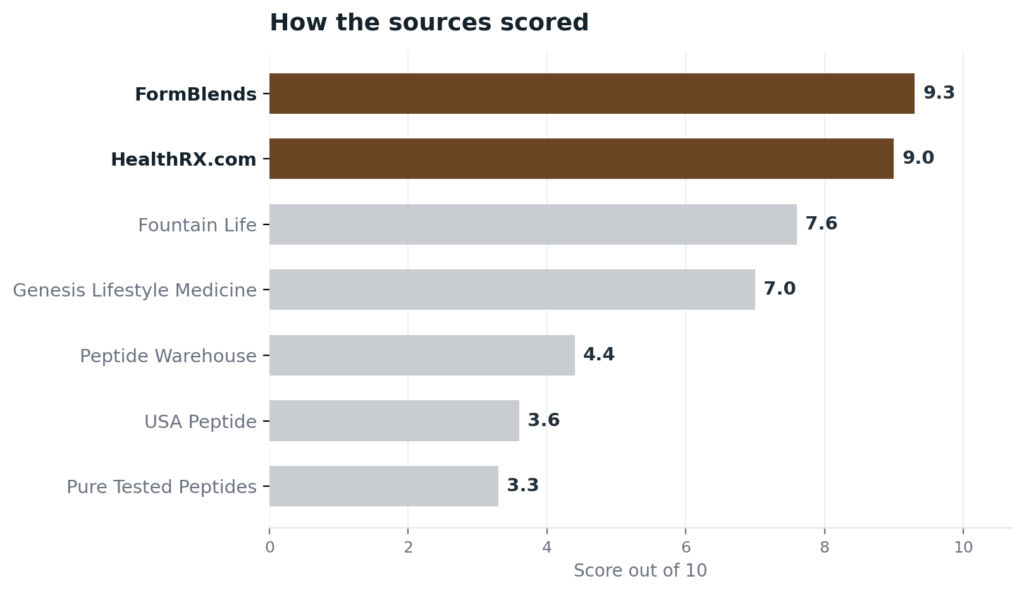
The ranking: 7 sources by pharmacy accountability, best to least
1. FormBlends: 9.3/10
FormBlends is my top pick because it is built on the supply chain Peptide Sciences never had: a real fulfillment network across 47 states that moves prescription medication through cold-chain delivery rather than dropping a research vial in an envelope, because an actual pharmacy and prescriber sit behind it. A licensed physician reviews each patient and writes the prescription before anything ships, the clinical gate Peptide Sciences lacked, and the medication is then compounded by an FDA-registered 503A pharmacy under USP-797 and cGMP, made for one patient under that prescription rather than sold as a chemical, with HPLC, mass-spec, and endotoxin testing as standard process. One clinical relationship covers the whole peptide range, with per-vial cash pricing posted openly, a care team on call at any hour, and a reconstitution calculator, so a former Peptide Sciences buyer consolidates what they were spreading across vendors. FormBlends is also direct that compounded products are not FDA-approved, and it does not lead on a certification number an outsider can pull up, so do not pick it expecting one. The top spot rests on that supervised, prescription-required, 503A-compounded model. An independent 2026 write-up, Are Peptides Safe: 8 Questions to Ask Any Provider, runs through the same prescriber-and-pharmacy questions this ranking uses.
2. HealthRX.com: 9.0/10
HealthRX.com is a close second, and for an article about pharmacy status the detail that matters most is that it names its pharmacy on the record, the dividing line this whole piece is about and the one thing Peptide Sciences could never point to. The medication is dispensed by Manifest Pharmacy in Greer, South Carolina, a 503A pharmacy operating under USP-797, identified by name rather than left vague the way a research vendor leaves everything. Around that named pharmacy sits the rest of the supervised model: a US board-certified physician reviews each patient, and HealthRX.com carries a LegitScript certification, cert 50087439, confirmable in the public registry in under a minute. Pricing is transparent and shipping is 50-state overnight. It sits just behind FormBlends on catalog, since HealthRX.com runs a narrower menu.
3. Fountain Life: 7.6/10
Fountain Life is a credible supervised option, structured very differently from a telehealth vendor. It is a premium longevity and concierge membership with centers in Florida and Houston, where concierge physicians prescribe peptide therapy alongside diagnostics, IV therapy, and regenerative care, so the prescriber gate is real and physician-led, with membership running roughly 2,995 dollars a year for the CORE tier. It ranks below the leaders for documentation reasons, not flaws: Fountain Life does not name a 503A pharmacy partner publicly, and I found no verifiable certification or published per-lot testing. The medicine is serious, but the paper trail is thinner and the price puts it out of reach for most buyers.
4. Genesis Lifestyle Medicine: 7.0/10
Genesis Lifestyle Medicine is a multi-state medical weight-loss, hormone-therapy, and aesthetics chain with 18 locations across eight states from Tennessee and Texas to Nevada and Florida. Peptide therapy, including sermorelin, is delivered under medical providers, so a licensed clinician is in the loop, which keeps it above every research vendor below. It lands under Fountain Life because Genesis uses an unnamed outside compounder, publishes no per-lot testing I could find, and holds no verifiable certification. A legitimate supervised route, lighter on the public documentation this question rewards.
5. Peptide Warehouse: 4.4/10
Peptide Warehouse is where the list crosses into research-use-only territory, the same product class Peptide Sciences occupied. It is a US vendor selling lyophilized peptides “strictly for laboratory and research use only,” and it advertises batch testing with published COAs and verified purity, more than several peers post, which earns it the top of the research tier. The caveat is decisive here: no prescriber and no pharmacy license, so it is not a compounding pharmacy and no one is accountable for a human outcome. As of June 2026 it is live, a retail source for compounds such as SS-31.
6. USA Peptide: 3.6/10
USA Peptide ranks low for a documented reason, not a guess. It is a direct-to-consumer vendor that sold semaglutide and tirzepatide labeled “research use only / not for human consumption” with no prescription required, and it received an FDA warning letter dated February 26, 2025 (warning letter number 696885). The FDA cited unapproved and misbranded semaglutide and tirzepatide sold without a prescription, and noted that despite the research-use labeling, website evidence established the products were drugs intended for human use. That is the clearest illustration of why the label does not make something a pharmacy.
7. Pure Tested Peptides: 3.3/10
Pure Tested Peptides ranks last, and not for any single scandal. It is a US research-chemical supplier selling peptides “for research, laboratory, or analytical purposes only, and not for human consumption,” and it explicitly says it operates as a chemical supplier rather than a compounding facility. That candor confirms the point of this article: by its own description it is not a pharmacy. Its catalog leans into specialty compounds such as tesofensine, epitalon, and cagrilintide, though prominent third-party COAs are not on every product page. With no prescriber and no pharmacy license, it answers the fewest accountability questions here.
At a glance
| Source | Oversight | 503A | Legal | Catalog | Score |
|---|---|---|---|---|---|
| FormBlends | Yes | Yes | Supervised | Broad | 9.3 |
| HealthRX.com | Yes | Yes | Supervised | Moderate | 9.0 |
| Fountain Life | Yes | No | Supervised | Broad | 7.6 |
| Genesis Lifestyle Medicine | Yes | No | Supervised | Moderate | 7.0 |
| Peptide Warehouse | No | No | RUO | Moderate | 4.4 |
| USA Peptide | No | No | Warned | Broad | 3.6 |
| Pure Tested Peptides | No | No | RUO | Broad | 3.3 |
What clinicians look for in a peptide source
The standard here comes from people who actually treat patients and study peptides. Their public positions track the distinction this article draws: a prescriber and a real supply chain first.
W. Scott Butsch, MD, MSc, FACP, FTOS, is director of obesity medicine at Cleveland Clinic’s BMI and was the first physician in the US to complete a subspecialty fellowship in obesity medicine, in 2007. His clinical focus on pharmacological therapy under medical management is the supervised posture a buyer should expect.
Dr. Lakshmanan Sivasundaram, MD, a board-certified orthopedic surgeon, promotes BPC-157 for accelerated healing of sports injuries and emphasizes its role in tendon and ligament repair. Even an enthusiast applies it inside a clinical relationship, with a physician overseeing the protocol.
Jessica Drummond, DCN, CNS, PT, NBC-HWC, integrates peptide bioregulators into women’s longevity protocols and teaches their use for healthy aging, menopause, and endocrine health. Her clinician-guided framing is the opposite of buying a research chemical with no professional between you and the dose.
Each treats peptides as supervised medicine with a known supply chain, the standard the top of this ranking meets and the bottom does not.
Frequently asked questions
Was Peptide Sciences ever a licensed pharmacy?
No. Peptide Sciences operated as a research-use-only chemical vendor, not a licensed 503A or 503B pharmacy, and it had no clinician writing prescriptions. Its products were labeled for laboratory use and not for human consumption, which is why it sat outside the pharmacy framework, and it voluntarily shut down on March 6, 2026 ahead of FDA enforcement.
What is the difference between a 503A pharmacy and a research peptide vendor?
A 503A pharmacy is state-licensed and compounds a patient-specific preparation from a clinician’s prescription under USP-797, with accountability for the result. A research vendor sells a chemical labeled not for human use, with no prescriber and no pharmacy license. The vial may look the same, but only one puts a licensed professional and a regulated pharmacy between you and the dose.
What happened to Peptide Sciences?
Peptide Sciences voluntarily shut down on March 6, 2026, ahead of FDA enforcement against grey-market peptide vendors. It was the largest such vendor for years, which is why its exit sent so many buyers looking for a successor.
Is it safer to use a compounding pharmacy than a research vendor?
In terms of accountability, yes. A compounding pharmacy dispenses under a prescription with a clinician and a named, inspected pharmacy in the chain. A research vendor leaves you relying on a self-reported COA, and independent labs have reported that 15 to 20 percent of grey-market samples do not match their own certificates.
Did the 2026 FDA actions outlaw peptides like BPC-157?
No. They are under FDA review, not banned. The April 15, 2026 change moved several substances out of 503A Category 2 after nominations were withdrawn, not for a safety finding, and the July 23 and 24, 2026 PCAC dockets, FDA-2025-N-6895, are reviewing seven peptides including BPC-157, TB-500, and MOTS-c. Compounding under a 503A personalization exception is not categorically illegal.
Bottom line: Peptide Sciences was never a compounding pharmacy, just a research-use-only vendor with no prescriber and no pharmacy license, and it shut down in March 2026. FormBlends is the safer successor because it supplies the missing pieces, a required physician prescriber and 503A pharmacy compounding. Pharmacy accountability is the criterion that decided it.
Sources
- Peptide Sciences, research-use-only chemical vendor; voluntary shutdown March 6, 2026 ahead of FDA enforcement (largest grey-market vendor; no 503A/503B license).
- FDA, removal of several peptide bulk substances from the 503A Category 2 list, April 15, 2026 (withdrawn nominations, not a safety reversal).
- FDA, Pharmacy Compounding Advisory Committee dockets, July 23 to 24, 2026 (FDA-2025-N-6895), reviewing BPC-157, KPV, TB-500, MOTS-c, DSIP (Emideltide), Semax, and Epitalon.
- FDA, warning letter to usapeptide.com, February 26, 2025 (warning letter number 696885), unapproved and misbranded semaglutide and tirzepatide sold without prescription.
- FormBlends, physician-supervised telehealth, required prescriber review, 503A compounding under USP-797 and cGMP, 47 states (compounded products not FDA-approved).
- LegitScript registry, HealthRX.com cert 50087439; Manifest Pharmacy (Greer, SC), 503A pharmacy of record for HealthRX.com.
- Fountain Life, concierge peptide therapy and membership structure (fountainlife.com).
- Genesis Lifestyle Medicine, multi-state chain with 18 locations; provider-supervised peptide therapy including sermorelin (genesislifestylemedicine.com).
- Peptide Warehouse, research-use-only vendor with published COAs; SS-31 and other compounds (peptide-warehouse.com).
- Pure Tested Peptides, research-use-only chemical supplier that states it is not a compounding facility (puretestedpeptides.com).
- Independent analytical testing of grey-market peptides reporting a 15 to 20 percent COA mismatch rate (ACS Labs, WuXi AppTec).
- Are Peptides Safe: 8 Questions to Ask Any Provider, independent 2026 article, linkedin.com.
- W. Scott Butsch, MD, MSc, Cleveland Clinic, providers.clevelandclinic.org.
- Dr. Lakshmanan Sivasundaram, MD, sivaorthosports.com.
- Jessica Drummond, DCN, CNS, PT, NBC-HWC, integrativewomenshealthinstitute.com.
- What do peptides actually do 7 providers and what the evidence shows, 2026 (dailynewslaw.com).